Whether to create a connection with your customer, convey information and announcements, or optimize your daily operations, it is important to know how to build an appropriate ambient sound project for your business. Additionally, it is essential to manage all media broadcasted to the audience.
It may seem simple, but today we will see that it is more complex than you might think. Let's go?
Discovering the Power of Ambient Sound...
More and more companies are discovering that ambient sound can be used for much more than just entertaining their consumers. After this discovery, investing in an IP audio system becomes almost inevitable.
Therefore, knowing what to consider when setting up a sound project is important so that the system meets the needs of your business, not only for today's demands but also for future ones that may arise.
With that in mind, we have separated some topics that can assist you on this journey, such as:
- Purpose: ambient sound can be used for various purposes within the same company, but defining its primary use can guide you in choosing the most suitable equipment and starting to understand your needs.
- Needs: understanding the needs of the space where the equipment will be installed is very important to know if there are noises, echoes, and other factors that may interfere with the performance of the speakers.
- Equipment: selecting the equipment and software to be used can be one of the most challenging parts, especially if you do not have the purpose and needs of your project well aligned. Another challenge that may arise is the choice itself, as there are many brands available in the market today, often complicating the selection process even further.
But you don't need to worry, as with the proper support from specialized companies in the field, such as SilliS, setting up an IP sound project will be much more practical and accurate for your business.
Now you might be wondering, “But what about after the system is up and running, how will I manage it?” and that is the next question we will explain.
Why Manage IP Audio?
Before we talk about how to manage an IP audio system, let's explore the benefits of management.
We know that IP audio can be used for various purposes, but the most common is ambient sound, which not only makes the space more pleasant for consumers but can also help them feel relaxed, consequently increasing their time spent in your business and elevating the chances of purchase on-site.
Moreover, IP audio can also be used to broadcast your own or third-party announcements and disseminate important information to your customers.
Both the first and second examples can be used separately or together, but it is important to have a system that allows for automatic pausing of a playlist so that another can play. This not only optimizes the work of employees but also ensures that the message reaches consumers' ears clearly.
Lastly, but no less important, IP audio also allows you to optimize your daily operations, often resulting in lower costs by not requiring a full-time person to manage the system.
Meet Simm.Pro
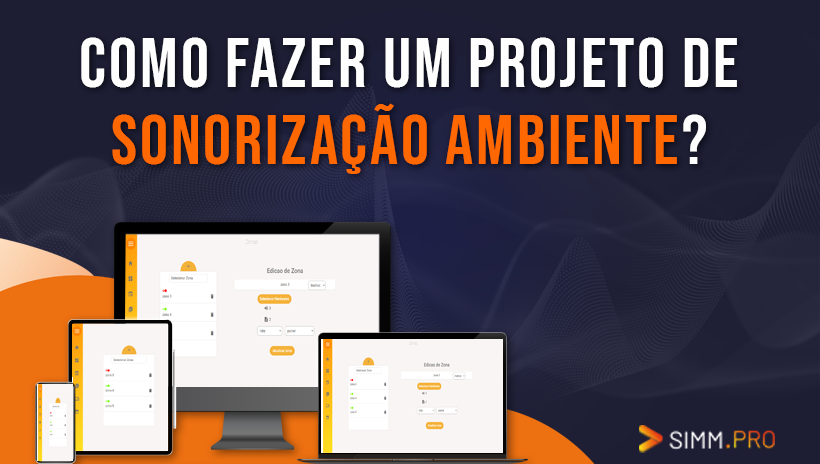
The SIMM.PRO Media Under Control is the most comprehensive media management software on the market, as it allows you to manage not only your company's speakers but also LED panels.
It enables control of all announcements, informational content, and ambient sounds that will be made throughout the day, week, month, or year all at once in an agile and proactive manner, facilitating your daily operations.
It is intuitive and has various features for registering hardware and for possible future changes. For example, when registering a piece of equipment in the system, you can specify whether it is an audio or text output, whether it is active or inactive, and its manufacturer.
Additionally, one of its advanced features allows for monitoring reports of online and offline hardware through Ping by IP and port every 15 seconds.
Another differentiator of SIMM.PRO is during the registration of zones, where you can indicate whether that area is active or inactive and designate a leader speaker – the one that will receive the information and disseminate the content among the others in the same zone – and a backup speaker – which will take over if the leader is not functioning.
Furthermore, in cases of audio playback, the user can select whether the volume of the schedule will be configured by zone or by the schedule itself, with standard volumes being: very low, low, medium, high, and very high.
There are so many benefits that it's hard to list them all, but here are a few:
- Playlist feature
- Internal audio recording feature
- Pause and reactivate scheduling feature
- Event programming feature via link
- Media storage repository (by folders and subfolders);
- Speaker failover feature within the same zone;
- Monitoring of media played in the last 24 hours and scheduled for the next 24 hours;
- Scheduling of daily, weekly, monthly, and annual repetitions selecting desired days with intervals of repetitions between minutes or hours and much more;
Extra: the SIMM.PRO is compatible with Axis speakers and can also work in conjunction with AXIS Manager Edge.
About Us
With 10 years in the market, SilliS is an IT integrator and software developer focused on providing cutting-edge security solutions, bringing to its clients the most innovative in video monitoring, access control, video walls, and much more!
Additionally, we offer a fully remote service and have a team of certified specialists ready to support your IT team and correct any possible failures in your surveillance system.
Now that you know how to set up an ambient sound project and the importance of managing audio, how about getting a quote with us?