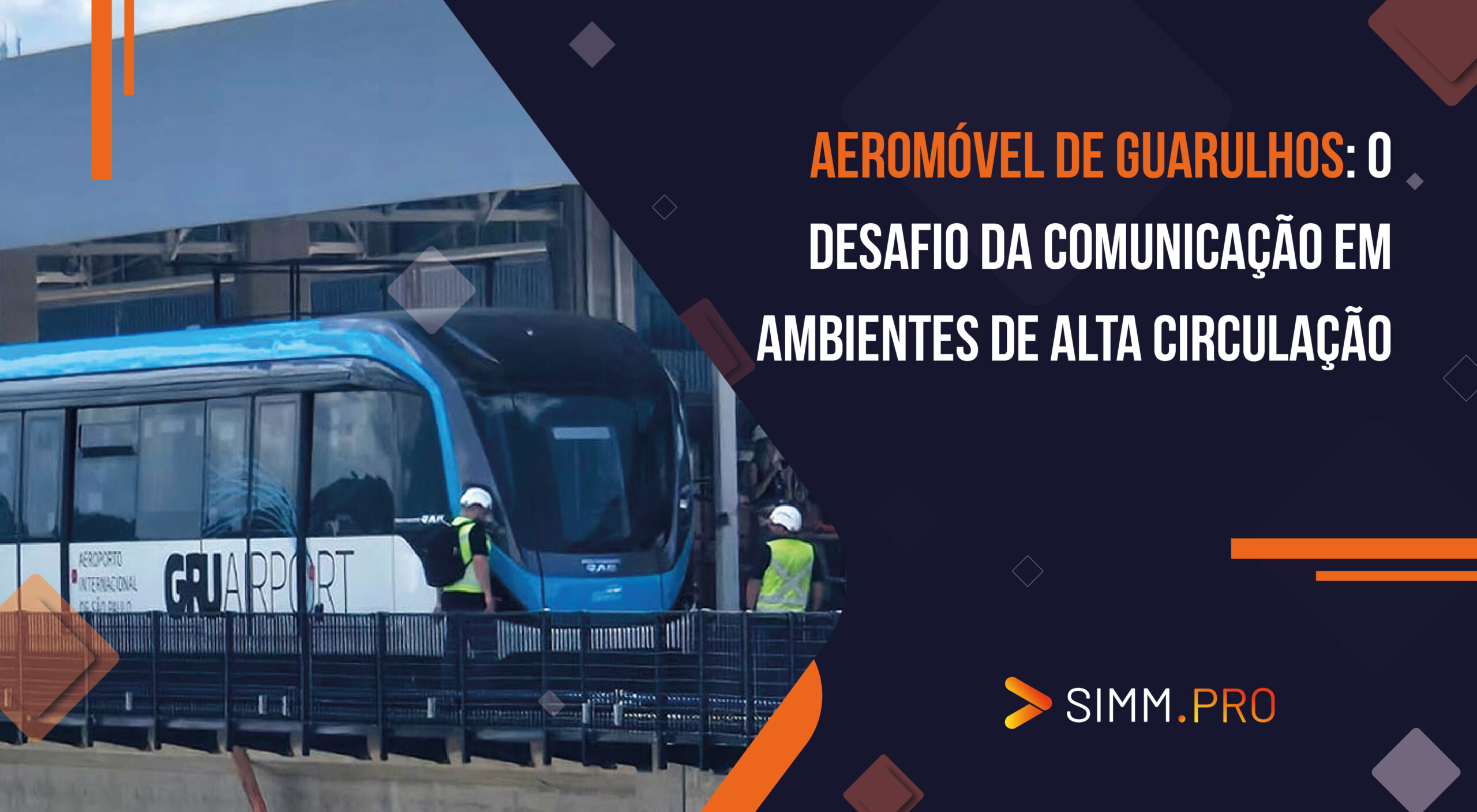
The anticipation for the opening of the Guarulhos Aeromobile is only increasing. The new system is designed to facilitate the movement of thousands of passengers every day, connecting different modes of transport and making access to São Paulo International Airport faster and more efficient.
But there is one point that many people do not realize when thinking about large mobility projects: the communication that takes place within these environments. In places with high passenger flow, transmitting information clearly, quickly, and in sync is essential for the operation to function smoothly.
Want to understand why communication is one of the pillars for the success of systems like Aerogru? Keep reading 😃
What is the importance of an integrated communication system in high-traffic environments?
In terminals, airports, and intermodal stations, thousands of people move around at the same time. Many of them are in a hurry, carrying luggage, trying to find platforms, connections, or updated schedules.
If the information is not organized and distributed correctly, the impact is immediate. Confusion, delays, crowding in specific areas, and operational difficulties can arise quickly.
That’s why communication systems need to go beyond isolated solutions. It is essential that audio, monitors, information panels, and operational messages work together. When everything is connected, information reaches the passenger consistently, regardless of the channel used.
Real-time communication for more efficient operations
Environments like the Guarulhos Aeromobile require constant updates of information. Platform changes, operational announcements, flow guidance, and safety communications need to be transmitted in real time.
When communication is centralized on a single platform, operations gain agility and control. Teams can schedule content, automate messages, and respond quickly to any situation.
This also reduces operational errors and improves coordination among different areas involved in the transportation system's operation.
Does the passenger experience also depend on communication?
Today, user experience is one of the most important factors in urban mobility projects. Passengers expect clear, accessible information at the right time.
Digital panels with real-time updates, well-distributed audio announcements, and strategic visual messages help people navigate more easily. This reduces travel stress, improves flow, and contributes to a more organized environment.
In modern transport hubs, communication is no longer just operational; it becomes part of the complete passenger experience.
The role of integrated platforms like SIMM.PRO
In this scenario, integrated solutions stand out. SIMM.PRO was developed specifically to meet the needs of complex mobility environments, bringing together audio, video, text, and connected device resources on a single platform.
With it, it is possible to manage different communication zones, schedule content, update information in real time, and ensure that important messages reach the right place at the right time.
In large-scale projects, such as systems that connect airports and urban transport, this integration makes all the difference in keeping operations organized, safe, and efficient.
Modern mobility demands intelligent communication
The evolution of urban mobility involves not only physical infrastructure or new modes of transport. The way information circulates within these environments is also an essential part of this transformation.
As projects like Aerogru come into operation, the need for technological solutions that can keep pace with the rhythm of cities and people also grows.
And in the end, when communication works well, everything flows better. For those operating the system and especially for those who pass through it every day.
Does your operation also need more integrated, efficient communication prepared for high-traffic environments? How about getting a quote from our specialized team?